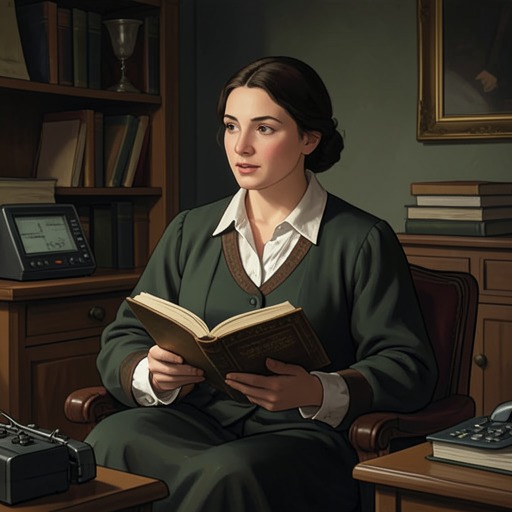
Marion has Tom read her story for Patrick, then leaves
My PolicemanMarion’s decision to have Tom read her manuscript to Patrick turns an approaching death into a final act of testimony and an occasion for separation. With Dr Wells warning that Patrick may have only a week to live, Marion asks her husband to speak to the man he has already lost once. Tom agrees to read her words at Patrick’s bedside; Marion then leaves Peacehaven, entrusting both the manuscript and the two men’s last hours to them.
The prognosis and the request
Marion makes the news face to face. She announces that Dr Wells has visited, waits while Tom plates his meal and eats, then asks him to sit with her. She has resolved not to lie to her husband’s back: she wants him to hear the truth directly. Her report is stark: “He said Patrick doesn’t have long to live.” Tom finishes his plate before answering that they have known this all along and that Patrick should go to a nursing home. Marion counters that there is no time for that; Patrick has a week, perhaps less.
The short exchange shifts the question from long-term care to the limited time remaining. Marion tells Tom that Dr Wells considers conversation vital, and that she cannot do it alone. When Tom asks what she means, she asks him to talk to Patrick. He does not immediately understand the request, so she specifies that he can read aloud: Patrick will not respond, but he can hear. The appeal makes listening, rather than recovery or a spoken reply, the immediate purpose of their contact.
A confession rather than revenge
Marion then tells Tom that she has written something she wants both men to hear. His surprise at the disclosure marks how privately she has kept the manuscript. When he asks about her silence, he speaks of his own: he has lost Patrick once already. Marion insists that the writing is not revenge but confession, and that it concerns her own wrongs rather than anyone else’s. The distinction defines what she is asking Tom to do. He is not being asked to endorse her account or settle an old argument; he is being asked to give Patrick access to it by reading.
Marion also recalls Tom’s earlier belief that Patrick needed him. She says that this remains true in the present, and pleads with him to read. Tom does not promise at once; he closes his eyes and says he will think about it. His eventual action is therefore a choice made after resistance and grief, rather than an automatic response to Marion’s request. The scene leaves the manuscript’s contents unstated in these passages, but makes its function explicit: it is Marion’s confession, offered as words for Tom to carry to Patrick.
The reading at Patrick’s bedside
The next morning, Marion tends to Patrick as usual, changing his bedclothes, bathing him and feeding him liquidised Weetabix through a straw. She tells him that Tom will soon come to sit with him. Her routine care continues alongside the approaching farewell, while Patrick watches her with what she describes as a hopeful light in his eyes. When she discovers Tom in the kitchen, he has returned from his regular early swim and offers her a cup of tea. They eat breakfast together, the first time since the morning Patrick spilled his cereal.
After breakfast, Marion retrieves the manuscript from the kitchen drawer, where she has kept it while half hoping Tom would find it. She puts it on the table and leaves the room. This quiet handover is the hinge of the event: rather than stay to supervise the reading, she makes space for Tom to decide what to do with the pages. She spends the time packing a small case and listening from her bedroom to his voice as he reads her thoughts aloud. The sound is at once frightening and wonderful to her, because her words now reach Patrick through the voice of the husband she is leaving.
At four that afternoon, Marion looks in on them. Tom is sitting close to Patrick’s bed, reading from her pages. Patrick is usually asleep at that hour, but now his eyes are open and fixed on Tom. His body is leaning to one side against the pillows Tom has arranged, and Tom briefly stumbles over a sentence before continuing. Marion turns on a corner lamp so they can see one another clearly. Neither man looks towards her; she slips out and softly closes the door. The scene gives the reading its own intimacy: Marion has enabled it, but does not claim a place between reader and listener.
Departure and the unfinished appeal
Marion has packed only a few essentials: a nightdress, a change of clothes, a washbag and a novel. She does not expect Tom to mind sending the rest later. She has no settled destination, but identifies Norwood as a place to begin because Julia still lives there. Marion wants to tell Julia the story, and also to hear what Julia has to say; after so much reliance on her own words, she wants another story. Her intended departure thus leads away from the household and towards a friendship she hopes to address, without promising what will happen there.
She says she will not look in on Patrick again and leaves the page on the kitchen table in the hope that Tom will read it to him. The final request is intimate but deliberately indirect: she hopes Tom will take Patrick’s hand as he reads. Marion cannot ask Patrick to forgive her, but she asks, through the page, for his ear, trusting him as a listener. The event ends not with reconciliation confirmed or an answer from Patrick, but with the reading continuing behind a closed door and Marion setting out to leave Peacehaven.